Introduction
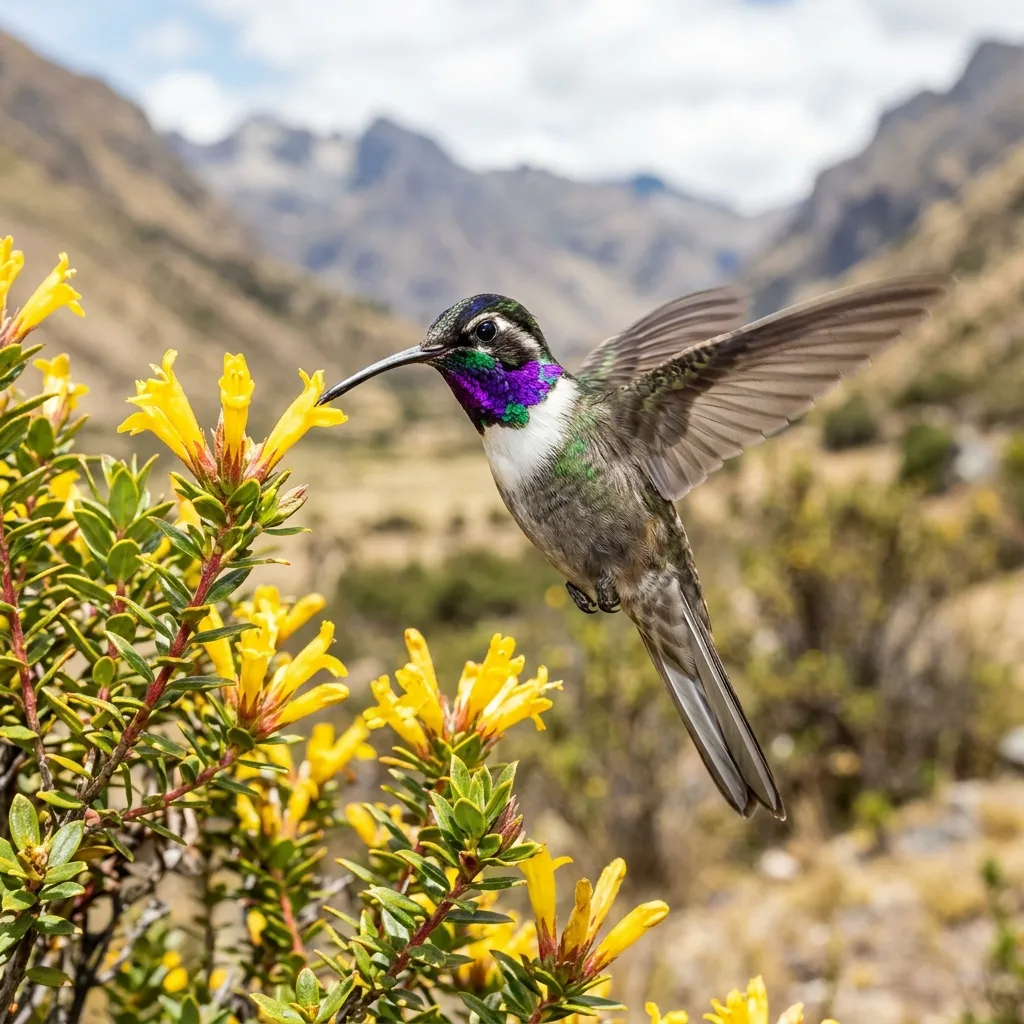
The Bearded Mountaineer (Oreonympha nobilis) is a large, spectacular hummingbird endemic to the high-altitude dry valleys and scrublands of the Peruvian Andes [2]. Occupying the high-elevation buffer zones leading into Manu National Park, this unique hummingbird is highly sought after by international birders due to its restricted range, distinct coloration, and unique foraging association with native tobacco trees.
Morphological Characteristics
Measuring up to 16.5 centimeters, the Bearded Mountaineer is one of the larger species of hummingbirds. Males possess a long, deeply forked tail with white outer feathers and a stunning iridescent green and purple throat patch (the 'beard'). The crown is a deep navy blue, the back is bronzy-brown, and the underparts are clean white. Females are similar but display a reduced throat ornament.
Feeding Adaptations and Nicotiana
Unlike many hummingbirds that feed on tubular red flowers, the Bearded Mountaineer has co-evolved a close feeding relationship with the yellow flowers of the wild tree tobacco (Nicotiana tomentosa) [3]. They are also known to feed on nectar from agave and cactus flowers, using their long, slightly decurved bills to access nectar. They aggressively defend productive patches from other hummingbirds.
Habitat and Altitudinal Distribution
This species is restricted to dry, rocky slopes, agricultural margins, and montane scrublands of the inter-Andean valleys, primarily in the departments of Cusco, Apurímac, and Huancavelica. In the context of a Manu expedition, they are typically found in the dry mountain rain shadow valleys before crossing the wet Acjanaco Pass into the cloud forest.
Tips for Birdwatchers
To add the Bearded Mountaineer to your checklist, plan to search the dry scrub habitats around the town of Pisac or the Huacarpay Lakes outside Cusco, prior to driving up the Manu Road. Look for flowering patches of Nicotiana trees. The birds are most active in the mid-morning and late afternoon, often perching conspicuously on bare branches between feeding bouts.
References & Scholarly Citations
- BirdLife International (2020). 'Oreonympha nobilis'. IUCN Red List of Threatened Species.
- Schulenberg, T. S. (2010). 'Birds of Peru'. Princeton University Press.
- Fjeldså, J., & Krabbe, N. (1990). 'Birds of the High Andes'. Zoological Museum, University of Copenhagen.
- Johnsgard, P. A. (1997). 'The Hummingbirds of North America' (References to Neotropical endemics).
Ready to Spot These Species?
Our custom birdwatching expeditions in Peru are designed for serious list keepers, photographers, and nature lovers alike. Join our small groups guided by top Peruvian ornithologists.
Inquire About Our Tours