Introduction
The cloud forests of the eastern Andean slopes host one of the highest concentrations of hummingbird species on earth. Spanning an altitudinal band of 2,000 meters, this habitat provides a near-constant supply of flowering plants, allowing over 40 species of hummingbirds to coexist by adapting to specific elevation zones and floral shapes [1].
Physiological Adaptation to Cold Nights
At high altitudes (above 2,500 meters), night temperatures can drop close to freezing. Because of their tiny size and high metabolic rate, hummingbirds cannot feed at night to maintain their body temperature. To survive, they enter a state of deep sleep known as torpor, during which their heart rate drops from 1,000 beats per minute to under 50, and their body temperature drops to match the ambient air.
Bill Evolution and Nectar Thieves
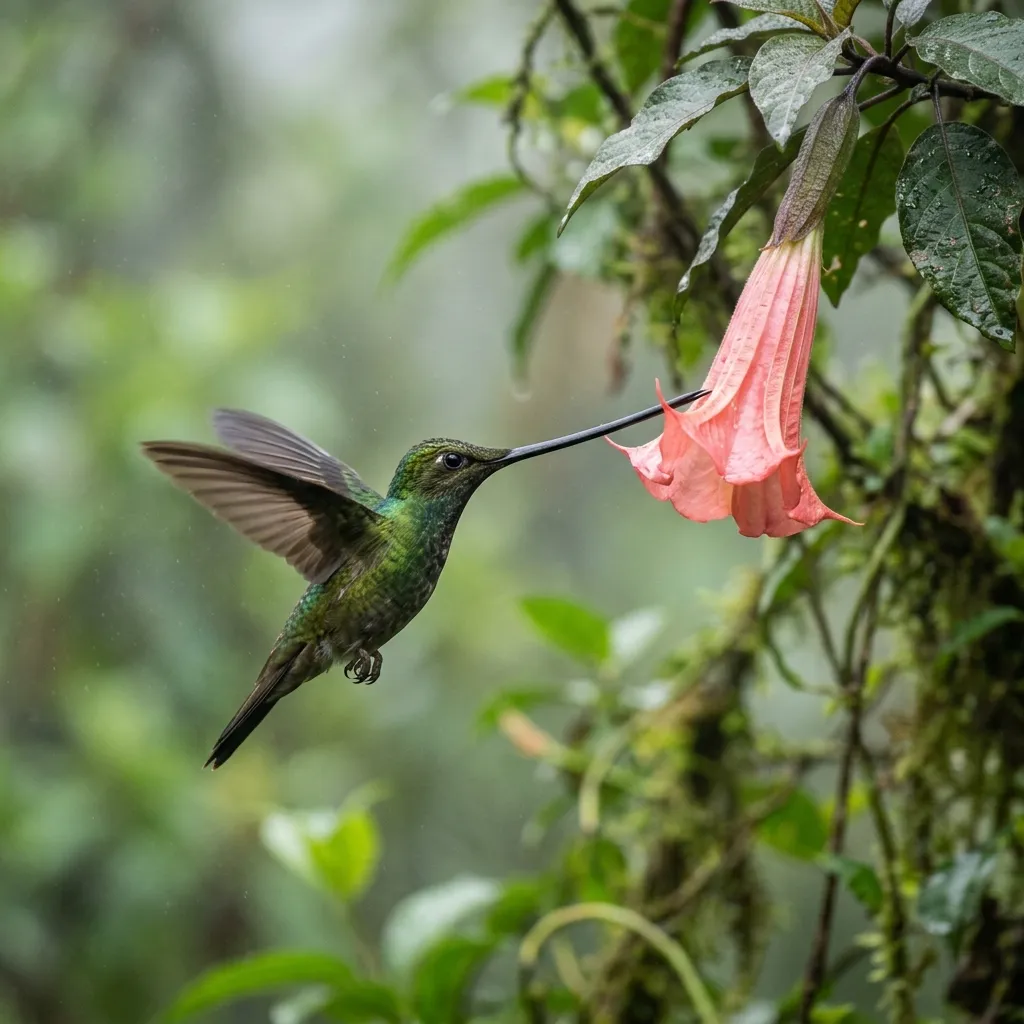
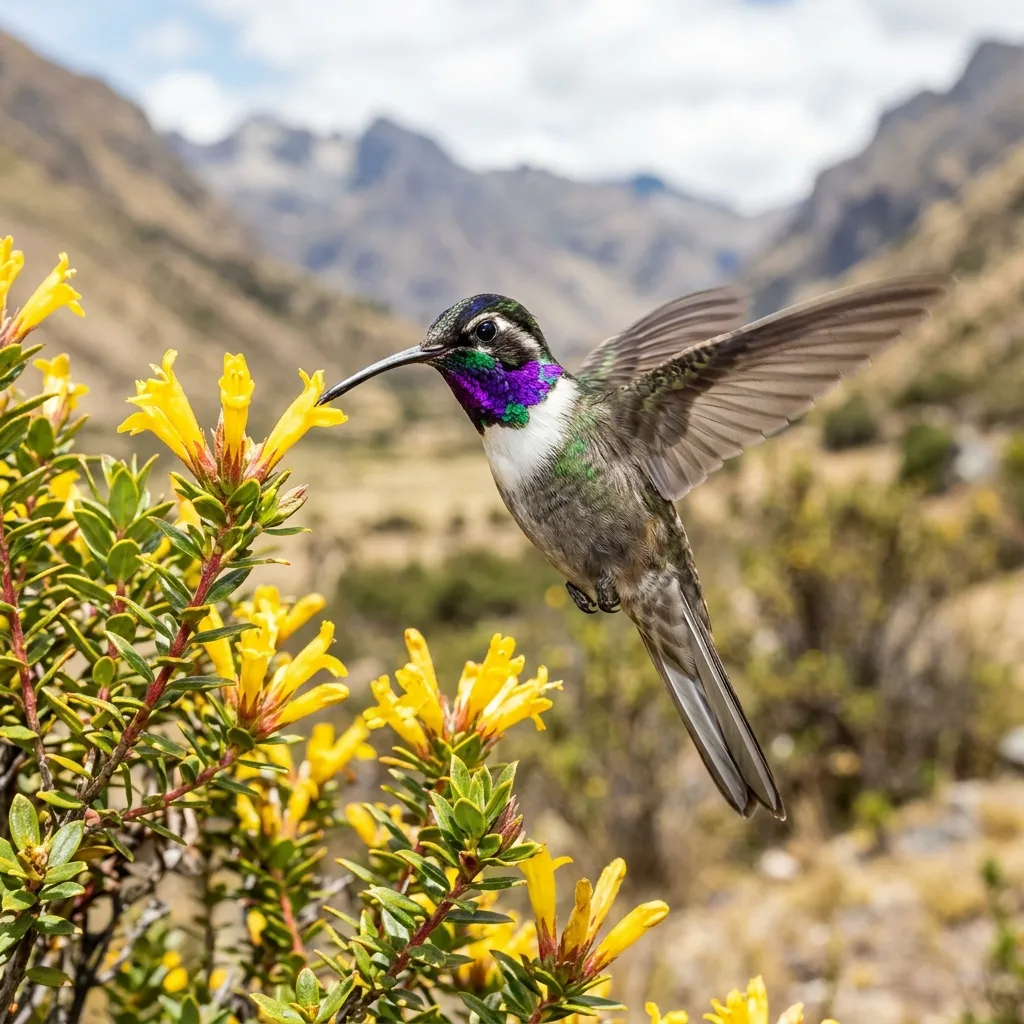
Hummingbirds and plants have co-evolved complex relationships. The Sword-billed Hummingbird, with a bill longer than its body, is the only species that can feed on the long, hanging flowers of the Datura tree. Other species, like the Violet-fronted Starfrontlet, have shorter bills and feed on shallow flowers, or act as 'nectar thieves', piercing the base of long flowers to extract nectar without pollinating the plant.
Spectacular Display Feathers
Males display incredible plumage ornaments to attract females. The Booted Racket-tail features long tail feathers with bare shafts ending in flat green disks ('rackets'), which it waves during aerial displays. The Amethyst-throated Sunangel displays a brilliant iridescent pink throat patch, while the Wire-crested Thorntail has long, thin feathers projecting from its crest.
Observation at Feeder Stations
The feeder stations at the Cock-of-the-Rock Lodge and the Wayqecha Biological Station offer some of the best hummingbird viewing in the world. Visitors can sit on comfortable verandas as dozens of hummingbirds buzz around the feeders, providing close-up views and photography opportunities of species that are otherwise difficult to spot in the dense forest canopy.
References & Scholarly Citations
- Fjeldså, J. (1990). 'Birds of the High Andes'. Zoological Museum, University of Copenhagen.
- Schulenberg, T. S. (2010). 'Birds of Peru'. Princeton University Press.
- Johnsgard, P. A. (1997). 'The Hummingbirds of North America' (Context on Neotropical diversity).
Ready to Spot These Species?
Our custom birdwatching expeditions in Peru are designed for serious list keepers, photographers, and nature lovers alike. Join our small groups guided by top Peruvian ornithologists.
Inquire About Our Tours