Introduction
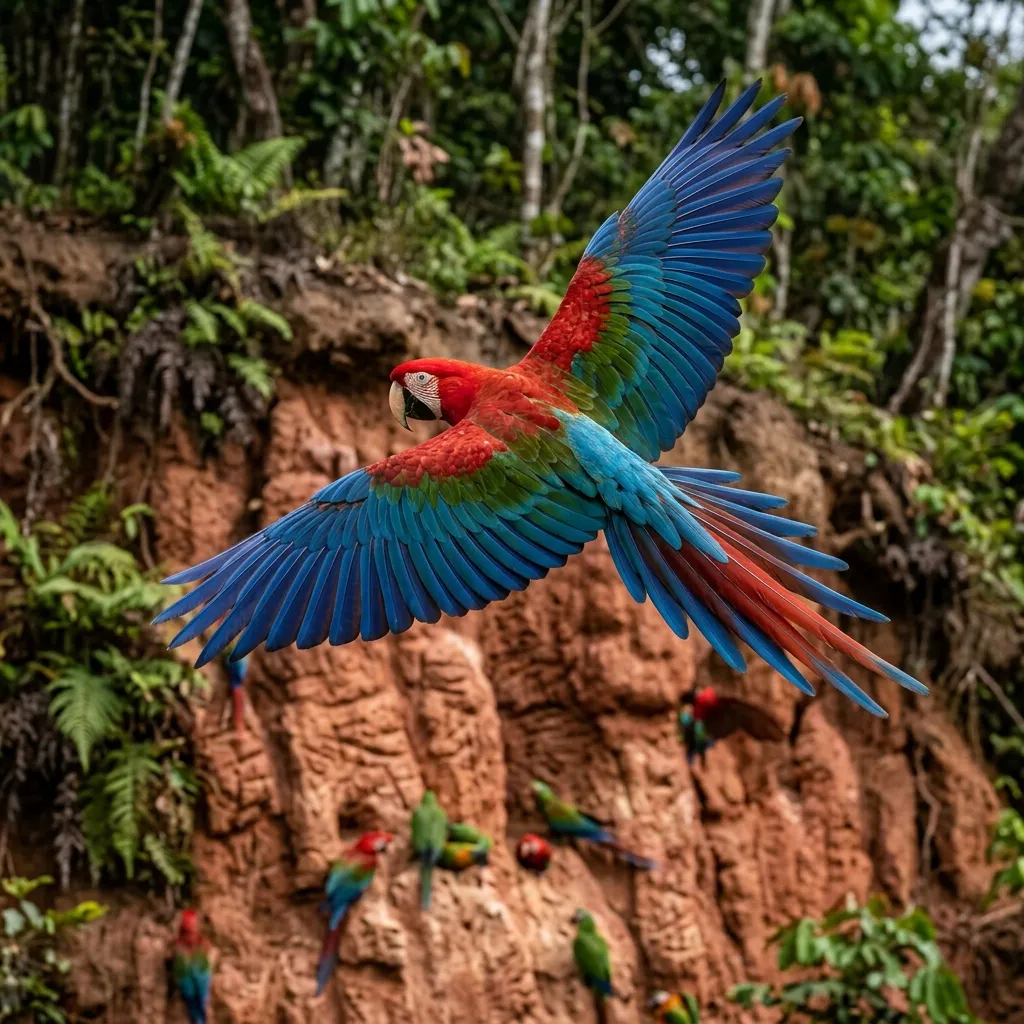
The Scarlet Macaw (Ara macao) is one of the most iconic symbols of the Amazon rainforest. Adorned in brilliant red, yellow, and blue plumage, these large, highly intelligent birds are frequently observed flying in pairs or large family groups across the lowland canopy of Manu National Park [2]. They are famous for their social intelligence, longevity, and their spectacular aggregations at mineral-rich clay licks.
Plumage and Physiology
A mature Scarlet Macaw can measure up to 96 cm from head to tail, with a tail composed of exceptionally long, pointed feathers. Their coloration is mostly scarlet-red, with a band of bright yellow feathers across the wings, leading into deep blue flight feathers. The face features white, featherless skin patches surrounding pale eyes, and their massive, hooked bill is adapted for cracking open extremely hard nuts and seeds.
The Science of Clay Licks (Colpas)
One of the most remarkable behaviors of Scarlet Macaws is geophagy—the consumption of soil. In the Manu lowlands, macaws gather at vertical riverbanks known as clay licks (or colpas) [3]. Scientific research indicates that the clay contains essential sodium minerals missing from their fruit diet, and the clay binds to dietary toxins (alkaloids) found in unripe seeds, neutralizing them in the bird's digestive tract.
Observation Guidelines in Manu
The Blanquillo Clay Lick, located on the banks of the Madre de Dios River, is the premier spot for viewing this behavior. Visitors sit in a camouflaged floating blind (hide) early in the morning to witness the macaws gathering on nearby trees before descending onto the clay face. Silent, respectful observation is critical, as macaws are highly sensitive to sudden movements and noises, which can trigger a mass panic flight.
References & Scholarly Citations
- BirdLife International (2020). 'Ara macao'. IUCN Red List of Threatened Species.
- Brightsmith, D. J. (2005). 'Parrot Conservation and Geophagy in Southeastern Peru'. Biotropica.
- Munn, C. A. (1992). 'Macaws: Giants of the Forest'. National Geographic.
- Forshaw, J. M. (2010). 'Parrots of the World'. Princeton University Press.


Ready to Spot These Species?
Our custom birdwatching expeditions in Peru are designed for serious list keepers, photographers, and nature lovers alike. Join our small groups guided by top Peruvian ornithologists.
Inquire About Our Tours
Social Behavior and Lifespan
Scarlet Macaws are highly social and form monogamous pairs that mate for life. They fly closely together, their wings almost touching, and communicate with loud, harsh screeches designed to carry over long distances through the dense jungle canopy. In the wild, they can live for 30 to 40 years, and up to 75 years in captivity, making their lifelong pair bonds a critical aspect of their reproductive biology.