Introduction
While Manu National Park is widely celebrated as a global birding capital, its dense forests, floodplains, and rivers host an equally extraordinary variety of non-avian wildlife. From apex predators like the jaguar to aquatic giants like the giant river otter, the park is a refuge for threatened species that have disappeared from other parts of South America [1]. Exploring Manu offers a complete, immersive wildlife experience.
Apex Predators: The Jaguar and Black Caiman
The lowland rainforest of Manu is one of the best places in South America to observe the Jaguar (Panthera onca). During the dry season (June to October), these magnificent cats are frequently spotted resting on the sunny sandbars of the Manu River. In the water, the dominant predator is the Black Caiman (Melanosuchus niger). Reaching lengths of up to 5 meters, these giant reptiles are commonly observed in the calm waters of oxbow lakes, where they hunt fish and waterbirds [2].
Aquatic Giants: The Giant River Otter
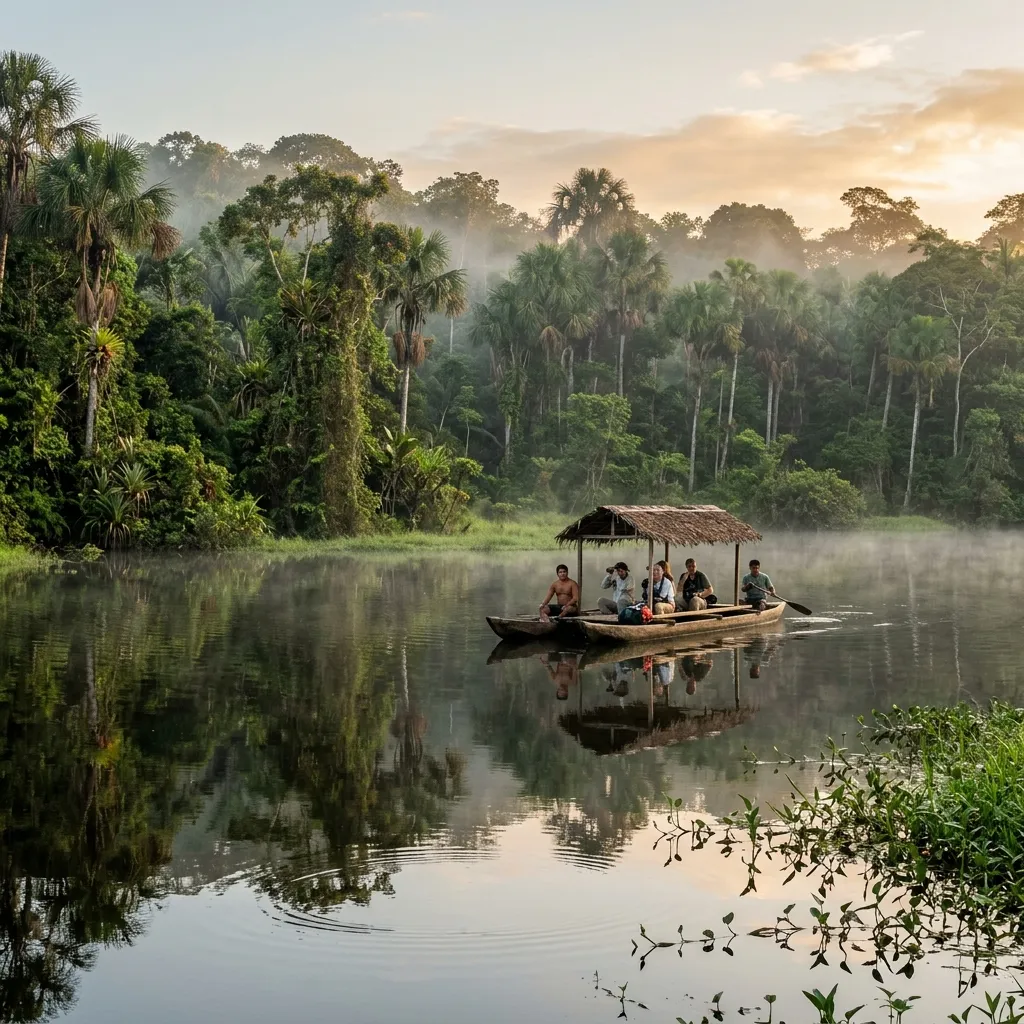
The oxbow lakes (cochas) of Manu, such as Cocha Salvador and Cocha Otorongo, are home to family groups of the endangered Giant River Otter (Pteronura brasiliensis). Known locally as lobos de río, these curious and highly vocal mammals can grow up to 1.8 meters long. They hunt cooperatively, feeding primarily on fish. Visitors can watch their social play and feeding behaviors from specialized catamaran platforms designed to minimize disturbance.
Rainforest Mammals: Monkeys and Tapirs
Manu's tree canopy is home to 14 primate species. Among the most popular are the tiny, white-mustached Emperor Tamarin, the acrobatic Black Spider Monkey, and the loud Red Howler Monkey, whose low, guttural roars echo through the forest at sunrise. On the forest floor, the largest herbivore is the nocturnal Lowland Tapir (Tapirus terrestris). Special blinds overlooking forest clay licks allow visitors to observe these unique mammals licking mineral-rich clay at night [3].
Reptiles, Amphibians, and Insects
Manu's smaller inhabitants are just as fascinating. Over 280 species of amphibians are found here, including vibrant poison dart frogs, tree frogs, and translucent glass frogs. Reptiles include green iguanas and the giant Anaconda. One of the most famous sights along the riverbanks is groups of butterflies gathering on the heads of Yellow-spotted River Turtles, drinking their sodium-rich tears [4], a beautiful symbiotic interaction.
References & Scholarly Citations
- Terborgh, J. (1990). 'Diversity and the Rain Forest'. Scientific American Library.
- Duellman, W. E. (2005). 'Cusco Amazónico: The Lives of Amphibians and Reptiles'.
- Emmons, L. H. (1997). 'Neotropical Rainforest Mammals: A Field Guide'.
- Schenck, C. (1998). 'Giant Otter Ecology and Conservation in Peru'. Frankfurt Zoological Society.

Ready to Spot These Species?
Our custom birdwatching expeditions in Peru are designed for serious list keepers, photographers, and nature lovers alike. Join our small groups guided by top Peruvian ornithologists.
Inquire About Our Tours