Why Every Peru Birding Trip Should Start in Lima
Nearly every international flight into Peru lands at Jorge Chávez International Airport in Lima, yet many visiting birders rush straight to their domestic connection without realizing that Lima's convergence of the frigid, nutrient-rich Humboldt Current, coastal freshwater marshes, fog-fed lomas oases, and steep western Andean canyons supports over 380 bird species within a two-hour radius.
Even a half-day layover in Miraflores or Barranco, or a single pre-tour day trip to Pantanos de Villa and Pucusana, reliably yields 60 to 95 species—including iconic specialty birds like the Inca Tern, Humboldt Penguin, Peruvian Seaside Cinclodes, Many-colored Rush Tyrant, and Peruvian Thick-knee that cannot be seen anywhere in Cusco or the Amazon.
Common Birds of Lima, Peru (Parks, Malecón & Urban Gardens)
If you have two hours between flights or a free morning along the cliffside parks of Miraflores (Parque Kennedy, Malecón Cisneros) or the historic olive grove of Bosque El Olivar in San Isidro, you can easily spot 20+ common birds of Lima, Peru right in the city:
| Bird Species | Scientific Name | Field Marks & Behavior | Best Urban Spot in Lima |
|---|---|---|---|
| Vermilion Flycatcher (Turtupilín) | Pyrocephalus obscurus | Brilliant crimson crown and underparts in males; dark melanistic morph also common in Lima | Bosque El Olivar (San Isidro) & Parque Reducto |
| Amazilia Hummingbird | Amazilis amazilia | Rufous belly, emerald chest, coral-red bill; aggressively defends hibiscus and shrimp plants | Miraflores Malecón & hotel gardens |
| Croaking Ground Dove & West Peruvian Dove | Columbina cruziana / Zenaida meloda | Bright yellow base to the bill (Croaking); pale blue eye-ring and white wing stripe (Cuculí) | Every park lawn and plaza across Lima |
| Scrub Blackbird & Cinereous Conebill | Dives warczewiczi / Conirostrum cinereum | Glossy melodious blackbird; hyperactive gray conebill gleaning insects from olive trees | Bosque El Olivar & Barranco parks |
| Red-masked Parakeet & Yellow-chevroned Parakeet | Psittacara erythrogenys / Brotogeris chiriri | Noisy emerald flocks with bright red heads (Red-masked) roosting in giant ficus trees | San Isidro, Miraflores & Surco |
| Harris's Hawk & American Kestrel | Parabuteo unicinctus / Falco sparverius | Chestnut-shouldered raptors hunting doves from palm crowns and apartment ledges | Bosque El Olivar & Costa Verde cliffs |
| Long-tailed Mockingbird & Saffron Finch | Mimus longicaudatus / Sicalis flaveola | Strikingly long graduated tail and bold facial mask; bright golden-yellow finches on lawns | Parque de las Leyendas & Miraflores cliffs |
Pantanos de Villa Wildlife Refuge (Wetlands, Shorebirds & Rush Tyrants)
Located just 35 minutes south of Miraflores in Chorrillos, Refugio de Vida Silvestre Los Pantanos de Villa is a 263-hectare Ramsar wetland fed by underground Andean aquifers emerging at the edge of the Pacific beach. Walking the reed-lined boardwalks of the Laguna Génesis and Maravilla circuits at dawn produces a spectacular concentration of waterbirds:
- Reedbed Jewels: The jewel-like Many-colored Rush Tyrant (Tachuris rubrigastra) and Wren-like Rushbird (Phleocryptes melanops) forage inches away in the totora reeds alongside Plumbeous Rail and Spotted Rail.
- Gulls, Terns & Skimmers: Resting flocks along the sandy beach immediately adjacent to the marsh contain thousands of Belcher's Gull, Gray Gull, Kelp Gull, Franklin's Gull (austral summer), Elegant Tern, Peruvian Tern, and Black Skimmer.
- Waterfowl & Grebes: Great Grebe, Pied-billed Grebe, White-cheeked Pintail, Cinnamon Teal, Peruvian Meadowlark, and coastal Peruvian Thick-knee (Hesperoburhinus superciliaris) resting in dry scrub behind the lagoons.
Pucusana Fishing Port: Inca Terns, Humboldt Penguins & Seaside Cinclodes
Continuing 45 minutes south of Pantanos de Villa down the Pan-American Highway brings you to Pucusana, a sheltered rocky fishing cove where a private 45-minute wooden boat excursion around the guano headland delivers unforgettable close-range photography of Humboldt Current specialties:
- Inca Tern (Larosterna inca): Hundreds of charcoal-gray terns with curling white handlebar mustaches and bright red bills hover at arm's length around fishing boats.
- Peruvian Seaside Cinclodes (Cinclodes taczanowskii): A strictly endemic ovenbird that hops over wave-splashed boulders alongside the Ruddy Turnstone, Surfbird, and Blackish Oystercatcher.
- Humboldt Penguin, Peruvian Booby & Red-legged Cormorant: Breeding pairs of vulnerable Humboldt Penguins (Spheniscus humboldti), blue-footed and Peruvian Boobies, Guanay Cormorants, and colorful Red-legged Cormorants (Poikilocarbo gaimardi) nest right on the guano-whitened cliff ledges.
Santa Eulalia Canyon & Lomas de Lachay (Full-Day Endemic Excursions)
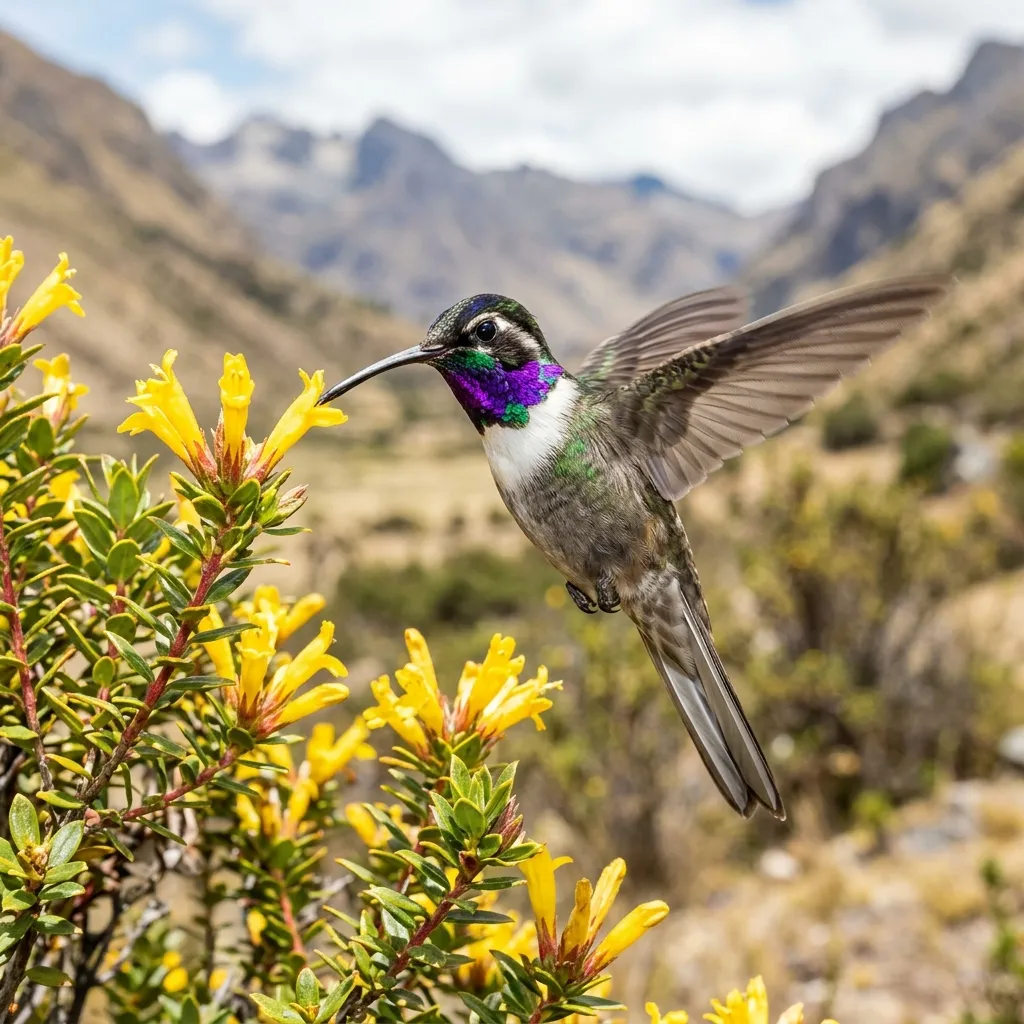
For birders with a full day before flying to Cusco, the Santa Eulalia Canyon (2 hours east of Lima) climbs rapidly from desert cactus scrub at 1,000 meters up to Polylepis woodland at 3,800 meters. Here you can score six Peruvian endemics in a single day: Great Inca-Finch, Rufous-breasted Warbling Finch, Rusty-bellied Brushfinch, Black-necked Woodpecker, Bronze-tailed Comet, and the enigmatic White-cheeked Cotinga.
Alternatively, north of Lima between June and October, coastal fog condenses on the foothills of Lomas de Lachay National Reserve, carpeting the desert in wildflowers and attracting the endemic Thick-billed Miner, Coastal Miner, Raimondi's Yellow-Finch, and Least Seedsnipe.
Frequently Asked Questions
What are the most common birds in Lima, Peru?
The most common birds in Lima's parks (such as Bosque El Olivar and the Miraflores Malecón) are the Vermilion Flycatcher (Turtupilín), Amazilia Hummingbird, West Peruvian Dove (Cuculí), Croaking Ground Dove, Scrub Blackbird, Long-tailed Mockingbird, Cinereous Conebill, Saffron Finch, Red-masked Parakeet, and Harris's Hawk.
Where can I see Inca Terns and Humboldt Penguins in Lima?
The easiest and closest place to see and photograph Inca Terns, Humboldt Penguins, Red-legged Cormorants, and the endemic Peruvian Seaside Cinclodes is the fishing port of Pucusana (60 km south of Miraflores) or the Palomino Islands boat tour from Callao.
Can I do a half-day birdwatching tour in Lima during an airport layover?
Yes. A 5-to-6-hour Lima birding layover combining Bosque El Olivar in San Isidro with Pantanos de Villa Wildlife Refuge in Chorrillos comfortably yields 55 to 75 bird species—including the Many-colored Rush Tyrant, Peruvian Thick-knee, and Humboldt Current gulls—before returning to the airport or your hotel.
When is the best time of year to visit Pantanos de Villa and Lomas de Lachay?
Pantanos de Villa is productive year-round, with peak numbers of North American migratory shorebirds, Franklin's Gulls, and terns present from September through March. Lomas de Lachay is best visited during the misty coastal green season from July through October.
References & Scholarly Citations
- Schulenberg, T. S., Stotz, D. F., Lane, D. F., O'Neill, J. P., & Parker, T. A. (2010). Birds of Peru: Revised and Updated Edition. Princeton University Press.
- Plenge, M. A. (2026). List of the Birds of Peru / Lista de las Aves del Perú. Unión de Ornitólogos del Perú (UNOP).
- SERNANP (2025). Plan Maestro del Refugio de Vida Silvestre Los Pantanos de Villa. Lima, Peru.

Ready to Spot These Species?
Our custom birdwatching expeditions in Peru are designed for serious list keepers, photographers, and nature lovers alike. Join our small groups guided by top Peruvian ornithologists.
Inquire About Our Tours